
Login

  BRITIXO   
Core CRM Software

Industry Specific
Software Solutions

Core
Features

Built-In
Modules

Resources &
Help Centre

Try Britixo For Free


Real Estate & Property Management Software
with Built-In PMS & CRM - UK Compliant & Focused.

The UK property market is fast-moving, complex, and highly competitive — with agencies, letting firms, and property managers juggling rent collection, maintenance, contracts, and client communication every day. Too often, these responsibilities are spread across spreadsheets, emails, and disconnected software, creating inefficiency and compliance risks. Britixo provides a smarter way forward. As an all-in-one Practice Management Software (PMS) with a built-in CRM, it is purpose-built for real estate and property firms in the UK. Unlike fragmented tools or US-centric platforms, Britixo centralises everything into one secure, GDPR-compliant system, enabling landlords, tenants, brokers, and agents to collaborate professionally in the cloud. Whether you’re a single-office agency in London or a multi-location real estate group, It helps you manage every client, contract & property more efficiently giving you the clarity and control to grow with confidence.
Our pricing is simple & flat, we don't charge against number pr properties, tenants or even landlord, it combines property management, CRM, billing, compliance, and automation in a single platform. 


Get Started For Free.

Free 14-Day Trial - NO CC REQUIRED*


Get Started For Free.

Free 14-Day Trial - NO CC REQUIRED*

Why Real Estate Firms Need PMS with CRM?

Running a property business in the UK involves far more than listings and sales. Agents and managers face challenges such as:

Real_Estate_Property_Management_Software_with_Built-In_PMS_CRM_UK


All in one - CRM, PMS & Practice Management - UK Compliant.
Complete Real Estate & Property Management Software

The Britixo real estate and property management module has been designed to bring together the day-to-day needs of property operations into one clear, connected workflow. Instead of treating properties, occupancies, maintenance matters, supplier work, service reporting, and communication as separate pieces, the module keeps everything organised around the full lifecycle of a property and the people connected to it. This guide explains the module in a practical, plain-speaking way, so visitors can understand not only what each feature does, but also why it matters in real operational use.

18Main sections covering the full property workflow from setup to service history.
Connected FlowEach area is built to work with the next, rather than operating in isolation.
Clear VisibilityDesigned to help teams keep property, maintenance, supplier, and reporting records aligned.
Responsive DesignBuilt to remain polished and easy to browse on desktop, tablet, and mobile devices.
🏠

1. Module Overview & Access

The real estate and property management module is built to give property-focused businesses a more organised way to manage records, relationships, maintenance activity, supplier work, communication, and documentation in one place. Rather than forcing teams to juggle separate tools or rely on disconnected notes, the module brings together the practical parts of property administration into one structured flow that is easier to understand and easier to manage over time.

A single working environment for real property operations

In day-to-day property management, the challenge is rarely just about storing information. The real challenge is keeping everything connected. A property has to remain linked to the right people. A maintenance issue needs to stay connected to the property it belongs to. A supplier job should not drift away from the original request that created it. Reports, communication, and historical records should all reflect the same operational picture. This module has been designed with that exact problem in mind.

Instead of building around one isolated feature, the module creates a joined-up path from property setup through to live service handling and later review. That gives teams a better sense of control because they can follow what happened, who was involved, and where each action sits in the bigger picture. The result is a more complete, more professional way to manage real estate and property-related workflows within Britixo.

What the module brings together

  • Property records that act as reliable operational anchors.
  • Relationship mapping between properties, landlords, and tenants.
  • Maintenance workflows that stay tied to the right property context.
  • Supplier-side job handling with clearer status visibility.
  • Reporting, communication, and service history that remain connected.

Why this structure matters

Property businesses often grow into operational complexity very quickly. Without a joined-up workflow, information becomes fragmented and teams spend too much time checking, re-checking, and manually stitching records together. A more connected module reduces that friction and makes daily operations easier to manage with confidence.

In simple terms

This module is designed to help property teams work from one clearer operational picture instead of dealing with multiple disconnected pieces of information.

🏢

2. Property Listings & Records

Every strong property workflow starts with a reliable property record. Within the module, property listings are not treated as simple placeholders. They are meant to function as the core records that later support occupancy, maintenance, supplier activity, and reporting.

Building the foundation properly

When property records are consistent and well-structured, everything that follows becomes easier. Staff can identify the right property more quickly. Linked users can act against the correct location. Maintenance matters can be raised with confidence. Reports make more sense because the source record itself is reliable. A strong property record therefore does far more than display an address; it becomes the foundation that supports almost every later part of the workflow.

This is especially important in environments where similar properties, repeated streets, multiple units, or changing relationships can otherwise create confusion. By treating the property record as a serious operational asset, the module helps reduce ambiguity and creates a stronger backbone for the full management process.

What a well-kept property record supports

  • Clearer recognition of each asset within the system.
  • Stronger use of property data across linked workflows.
  • Better continuity when the record is referenced later.
  • More professional presentation throughout the module.

The wider impact

If the property record is weak, every later step becomes heavier. If the property record is strong, everything from maintenance to supplier handling becomes smoother, clearer, and more dependable.

📍

3. Property Address Management

Address structure plays a much bigger role in property management than many systems allow for. The module uses a clearer address model so that properties are easier to identify, easier to search, and easier to work with consistently over time.

Keeping address data neat, readable, and useful

One of the most common causes of confusion in property systems is inconsistent address entry. Some users type a full description into one field. Others abbreviate. Others use different ordering. Over time, that makes search less reliable and creates more work for staff. The module improves this by using a structured address layout that gives each important part of the property its proper place.

Fields such as Building Name, House Number, Street Name, City, and Postcode help make the address easier to understand and more practical across the system. It becomes simpler to display the property cleanly in dropdowns, linked-property views, lists, and internal records. More importantly, it allows properties to be identified in a more natural way by the people using the system every day.

Address handling benefits

  • Cleaner and more recognisable property labels.
  • Better search and filtering behaviour.
  • Reduced ambiguity where similar addresses exist.
  • Improved usability across tenant, admin, and supplier workflows.

Why this is valuable

Property teams do not want to waste time deciphering records or guessing whether two differently written entries refer to the same place. A more disciplined address structure removes that friction and supports much cleaner operations.

Building Name House Number Street Name City Postcode Clear Display Labels
🔗

4. Landlord, Tenant & Property Linking

Properties become much more useful when they are connected to the right people in the right way. The module includes a linking structure that helps map relationships between properties, landlords, tenants, and other relevant parties with greater clarity and control.

Turning a property record into a living operational record

A property on its own is only part of the story. The real operational value comes from understanding who is connected to it and in what role. That is why linking matters. The module allows relationships to be handled in a more structured way, helping teams understand current responsibility, current occupancy, and the wider context around the property itself. This makes records more meaningful and helps avoid the uncertainty that often comes from relying on assumptions or scattered notes.

When these relationships are tracked properly, the property record becomes far more than a static entry. It becomes a living operational record that reflects real-world use. That in turn makes later workflows more dependable because maintenance issues, communications, and historical events can be understood in relation to the people actually connected to the property at the time.

What better linking improves

  • Visibility over who is associated with a property.
  • Clarity between ownership and occupancy relationships.
  • Stronger context for maintenance and service activity.
  • Better continuity when reviewing the property later.

Operational reality

In real property work, people change, tenancies change, responsibilities shift, and history matters. Structured linking gives the module the depth it needs to reflect that reality properly.

🔄

5. End Tenancy & Transfer Landlord

Property relationships do not remain fixed forever. Tenancies end, responsibilities change, and new arrangements begin. The module supports these transitions in a more controlled way so that change does not damage the historical value of the record.

Managing change without losing the past

One of the most important signs of a mature property system is how it handles change. A weak system overwrites relationships and makes it difficult to understand what happened before. A stronger system allows changes to take place while preserving earlier links for reference and accountability. This module follows that stronger approach. It recognises that ending a tenancy or transferring landlord responsibility is not just an update to a form; it is an operational event that may still matter long after the current relationship has moved on.

By preserving history, the module keeps the property journey understandable. Teams can later review who was linked to a property at a particular point in time, which is often important when looking back at service requests, communications, or decisions. That makes the record more trustworthy and helps avoid the common problem of losing useful context every time a property relationship changes.

What this approach protects

  • Historical visibility over earlier occupancy or responsibility.
  • Continuity across changes in property-related relationships.
  • Stronger confidence during handovers and later reviews.
  • A more reliable long-term record of how the property was managed.

Why it matters in practice

When businesses need to look back, they should not be forced to guess who was connected to a property before the current arrangement. Preserved relationship history makes review much more accurate and much more useful.

👥

6. Client / Tenant Property View

The tenant or client experience should feel clear and relevant, not overloaded. The module supports a more guided property view so that linked users can interact with the correct property records without needing to interpret the internal complexity behind them.

Giving users the right context without the noise

For tenants and linked clients, the most important thing is being able to identify the correct property quickly and act within the right context. They should not have to type out addresses from memory or guess which record belongs to them. By working from linked property relationships, the module simplifies that experience and helps users operate with more confidence. The property they see is the property they are connected to, which reduces errors and improves the quality of what they submit later.

This also helps the administrative side. When users work from linked property records rather than free-text entry, the requests they create arrive in a cleaner and more structured form. That means less correction work for staff and a much better chance that the request will move through the right operational route from the start.

Benefits for linked users

  • Easier identification of the correct property.
  • Less confusion during property-specific actions.
  • Reduced reliance on manually re-entering location details.
  • A smoother and more reassuring user experience.

Benefits for internal teams

When users start from the correct property context, internal teams spend less time fixing avoidable mistakes and more time progressing real operational work.

🛠️

7. Maintenance Request Creation

Maintenance handling begins with the quality of the request itself. If the request starts with poor context, everything afterward becomes slower and more difficult. The module is designed to make the first stage cleaner, clearer, and far more useful for everyone involved.

Starting a service case properly

In many systems, maintenance requests begin with loosely typed information that later has to be interpreted, corrected, or chased. The Britixo approach is much more structured. By letting users work from linked properties, the request begins with the correct location already in place. That immediately raises the quality of the record because the team handling the request can see exactly which property is involved without first having to resolve uncertainty.

A better maintenance request does not only save time; it also improves the quality of the whole service chain. The right property context leads to cleaner ticket handling, more accurate supplier allocation, stronger reporting, and a better audit trail later. It is a simple improvement at the start, but it has a powerful effect on everything that follows.

What a strong request should include

  • The correct property already attached to the record.
  • A clear description of the issue being reported.
  • Any helpful notes or supporting attachments.
  • A format that can be understood immediately by the internal team.

Why this helps later

Good request creation reduces confusion, cuts out unnecessary admin work, and gives the team a stronger base for review, action, and later documentation.

A practical truth

Most service issues become easier to manage when they begin with clear, correct, and complete property context. That is exactly what this part of the module aims to achieve.

📋

8. Maintenance Ticket Management

Once a request has been raised, the internal team needs to review it, understand it, and move it through the right operational path. This section of the module supports the management side of that process with clearer visibility and more structured handling.

Turning incoming requests into manageable work

A maintenance request only becomes useful when it can be reviewed properly and progressed with confidence. The module helps with this by keeping property context, user information, service details, and supporting files close to the ticket itself. That reduces the need for constant cross-checking and allows administrators to understand the case more quickly when deciding what should happen next.

As the number of requests grows, management discipline becomes even more important. Teams need to be able to find cases quickly, understand which stage they are at, and keep the service trail readable over time. The module supports that kind of day-to-day practicality, helping businesses move away from messy inbox-style handling and toward a more organised maintenance workflow.

What effective ticket management depends on

  • Clear visibility over the property and issue context.
  • Understandable status handling as the matter progresses.
  • Easy access to supporting notes and evidence.
  • The ability to move from review into action without losing continuity.

The operational benefit

Well-managed tickets make it much easier to keep service work organised, accountable, and traceable. That improves not only staff efficiency, but also the quality of the wider property management experience.

🚚

9. Supplier Allocation & Job Assignment

When a maintenance request needs supplier involvement, the handover must be clear and well-structured. This part of the module helps transform an internal maintenance matter into a controlled supplier-side job without losing the case context that makes the work understandable.

Assigning work with context still intact

Supplier allocation is one of the most important points in the service journey. If the handover is weak, the supplier may lack proper understanding of the property, the issue, or the history behind the case. The module is designed to keep that context with the job so that the supplier is working from something meaningful rather than receiving a disconnected instruction. This creates a stronger operational bridge between the original maintenance request and the actual work being carried out.

That linkage also matters later. When the supplier job stays tied to the originating maintenance case, internal teams can follow the service journey more clearly. Reporting becomes easier, review becomes more accurate, and financial handling later on remains grounded in the original reason the job existed in the first place.

What good supplier allocation achieves

  • A clearer handover from internal review to external execution.
  • Better understanding for the supplier carrying out the work.
  • Stronger continuity between request, job, and later reporting.
  • More reliable service oversight from the management side.

Why this is essential

Once a case leaves internal review and moves into supplier execution, the module must keep the operational chain intact. That is what turns supplier work into a managed process rather than an isolated side activity.

🧰

10. Supplier Portal Workflow

The supplier portal gives external service partners a dedicated working area that remains connected to the wider module. It is built to help suppliers focus on the jobs that matter to them while still preserving the operational visibility that internal teams need.

A cleaner supplier-side working experience

Suppliers need a practical interface that lets them understand their active work, review progression, and keep track of what has already happened. The portal supports this by organising jobs into clearer working areas such as active tasks, payout-related activity, and historical records. This makes the supplier experience more focused and easier to use without stripping away the important context that keeps the work connected to the original property case.

For property businesses, this is equally valuable. It means supplier interaction can be brought into the operational flow rather than being handled entirely outside the system. That improves visibility, reduces follow-up confusion, and helps everyone work from a more consistent understanding of what stage a job has reached.

What the supplier portal supports

  • Clear access to active jobs and current responsibilities.
  • Visibility over pending and historical job-related activity.
  • A more structured way for suppliers to work within the process.
  • Better continuity between supplier-side actions and admin-side oversight.

Why this helps the wider business

When suppliers work inside a cleaner and more structured portal, the entire service journey becomes easier to follow, easier to manage, and easier to trust.

⏱️

11. Supplier Job Status Lifecycle

Service work should move through clear stages, not vague labels. The module uses a disciplined supplier status lifecycle so that everyone involved can understand where a job truly stands and what that stage means operationally.

Keeping job progression meaningful

A status is more than a label. It tells the team whether a job has only just been assigned, whether the supplier has accepted responsibility, whether work is underway, whether the job is complete, or whether it has been cancelled. When these stages are handled clearly, the workflow becomes much easier to manage. Staff can see what is really happening. Suppliers know what is expected. Historical records remain understandable long after the work itself has ended.

This also matters because some later actions depend on specific statuses. Completion should not be confused with simple acknowledgment. Cancellation should not be mistaken for completion. By keeping the lifecycle structured, the module gives the business a stronger operational language for supplier work and avoids the ambiguity that weak status systems often create.

Core job stages

  • Job Allocated
  • Acknowledged / Accepted
  • In Progress
  • Completed
  • Cancelled / Void

The practical outcome

Clear stages reduce confusion, improve communication, and make the job history much easier to interpret. That helps both live management and later review.

Why this makes a difference

When statuses are meaningful and consistent, the entire supplier workflow feels more professional, more controlled, and more dependable from start to finish.

🖼️

12. Image & Attachment Handling

Images and attachments often carry some of the most important evidence in a property-related case. The module supports more disciplined media handling so that files remain associated with the right request, the right job, and the right operational history.

Keeping visual evidence useful and trustworthy

When a maintenance issue is reported, images can quickly become central to the case. They may help explain the problem, show urgency, support internal review, or later confirm the state of the work. If those images become mixed across cases or disconnected from the request they belong to, trust in the record drops immediately. That is why structured attachment handling is such an important part of the module.

By helping keep media tied to the correct request and later making it available in related workflows and reporting, the module turns attachments into a much more useful part of the operational story. Staff can review them more confidently, suppliers can work from better context, and final documentation becomes more meaningful because the visual record has remained intact.

What disciplined file handling improves

  • Cleaner case-based separation of attachments.
  • Better trust in the visual history of the issue.
  • More useful review and reporting later on.
  • A stronger link between evidence and operational activity.

Why this matters to service quality

In property operations, seeing the issue clearly can change the speed and quality of response. Good media handling makes that possible in a reliable way.

💷

13. Supplier Invoicing & Payouts

Once work has been completed, the financial side must remain just as clear as the service side. The module supports a better view of invoiced work, payment progression, and historical settlement so that financial handling stays tied to real operational outcomes.

Separating work completion from payment completion

A job being finished does not necessarily mean the financial side is finished as well. A supplier may have raised an amount, an internal team may still be reviewing it, and payment may happen later. The module supports that distinction by helping businesses see invoiced amounts and paid amounts as separate stages of the journey. This creates a more honest and more useful financial picture.

For internal teams, that means better control over what has been claimed, what remains pending, and what has already been settled. For suppliers, it gives clearer visibility over where their completed work sits in the payout process. For the business overall, it reduces confusion and helps keep the financial story aligned with the actual service history behind it.

Financial visibility includes

  • Tracking work that has been invoiced.
  • Separating invoiced value from paid value.
  • Seeing what remains pending.
  • Preserving settled payout history for future reference.

Why clarity matters here

Financial misunderstanding creates friction very quickly. A cleaner payout structure helps protect trust, improve review, and keep the supplier journey as well managed as the service journey itself.

14. Tenant Feedback System

Closing a maintenance case should not be the end of the story. The quality of the outcome also matters. The tenant feedback system gives the module a way to capture that final layer of the service experience in a more meaningful and measurable way.

Turning completion into useful service insight

A job may be marked as complete, but the user experience behind that job can still vary widely. Was the issue handled properly. Was the outcome satisfactory. Was communication clear. Feedback helps answer those questions. By allowing the module to record ratings, notes, and even supporting attachments, the tenant perspective becomes part of the service record instead of being lost after completion.

This is valuable because service quality should not be judged only from the admin side. A stronger property management process takes into account how the outcome was received by the person living with the issue. Over time, this creates a better basis for learning, review, and service improvement across the wider operation.

What feedback can include

  • Tenant ratings that reflect service satisfaction.
  • Written feedback for more detailed perspective.
  • Optional supporting evidence where relevant.
  • A recorded submission point within the service history.

Why this strengthens the module

Feedback turns service completion into something richer than a closed status. It gives the business a better view of quality and helps make the record feel more complete from the tenant’s side as well.

📄

15. PDF Reports & Document Output

Professional reporting is essential in property work. A well-prepared document should help someone understand the case clearly without needing to jump through multiple screens to piece together the background. The module supports that by producing richer, more useful document output.

Bringing the full case story into one report

A good report should do more than restate a title and a status. It should explain which property was involved, what the issue was, who raised or handled the matter, what supporting images existed, how the job progressed, and how the service ended. When these details come together properly, the document becomes much more valuable for review, sharing, record keeping, and long-term reference.

This kind of reporting is especially useful in real estate and property environments where the same case may later need to be reviewed by different people at different stages. A document that already carries the key context saves time, reduces confusion, and gives the business a much stronger standard of professional documentation overall.

What makes a report useful

  • Clear identification of the property and job.
  • Readable explanation of the issue and service journey.
  • Relevant images and supporting evidence where needed.
  • Outcome details that complete the record properly.

The wider value

Better reporting raises the standard of the whole module. It improves internal visibility, makes reviews easier, and helps the business present a much more professional record of its work.

✉️

16. Email Notifications & Communication

Property workflows often involve multiple people at once. If communication is not handled well, progress can quickly become unclear. The module supports more structured communication so that key parties remain informed as cases move through the workflow.

Helping everyone stay aligned

In a live maintenance or supplier case, different people may need updates at different points. That can include the supplier, the linked tenant or client, and the internal team managing the work. If those updates rely only on manual follow-up, delays and inconsistencies are much more likely. A more structured notification flow improves that situation by keeping communication tied more closely to real operational change.

This not only supports efficiency, but also strengthens the experience for everyone involved. Users feel better informed, suppliers stay aligned with current case movement, and internal teams can rely less on fragmented side communication. The result is a cleaner and more professional communication standard throughout the module.

What better communication supports

  • Greater clarity during live service progression.
  • Reduced dependency on separate manual updates.
  • A more consistent experience for all concerned parties.
  • Stronger trust that the workflow is being handled properly.

Why it matters operationally

When communication stays aligned with real workflow events, the whole case feels more controlled, more transparent, and more professionally managed.

🔎

17. Search, Filters & Interface Utilities

A powerful module also needs to be practical. Search tools, filters, pagination, and cleaner display behaviour make a huge difference once data volume starts to grow. These interface improvements help keep the system fast to work with and easier to understand every day.

Making the module easier to use at scale

As more properties, tenants, suppliers, and maintenance cases accumulate, day-to-day usability becomes more important than ever. Teams need to find records quickly, move through lists without frustration, and recognise the right entries without stopping to decode them. That is why the module benefits from utilities like improved search, clearer property labels, cleaner status display, and stronger table usability.

These may sound like smaller enhancements, but in practice they often have a major effect on how a platform feels. A system that is technically capable but slow to navigate can become frustrating very quickly. A system that is clear and efficient in everyday use becomes much easier to adopt and much easier to trust as the workload increases.

What these utilities improve

  • Speed of navigation through large record sets.
  • Confidence when selecting the correct item or property.
  • Reduced clutter in working tables and lists.
  • A more polished and efficient experience overall.

The day-to-day payoff

Better usability means less wasted time, fewer avoidable mistakes, and a more comfortable experience for the people relying on the system every single day.

⚙️

18. Installation, Portability & Module Continuity

A well-designed module should not only work now; it should remain dependable as it evolves. This final section is about continuity — making sure the module can be maintained, carried forward, and improved without weakening the stability of the operational workflow it supports.

Thinking beyond the immediate feature set

Real estate and property management workflows are not static. Businesses grow, records increase, requirements evolve, and the module has to continue supporting that journey. That is why continuity matters. Features need to remain grounded in a structure that can be maintained sensibly over time. Changes should strengthen the workflow, not create hidden instability that later affects live operations.

Portability and continuity also matter because property teams rely on trust in their systems. If the module supports reliable record handling, dependable service history, and clearer operational continuity, it becomes much easier to build on. A strong underlying approach helps ensure that growth, improvement, and maintenance can all happen without compromising the value already created inside the workflow.

What long-term continuity depends on

  • Stable structure behind the visible feature set.
  • Thoughtful handling of module changes over time.
  • Protection of the workflows businesses already rely on.
  • Confidence that the module can continue evolving sensibly.

Why this completes the picture

A module becomes truly valuable when it is not only useful today, but also dependable tomorrow. Continuity is what turns a collection of features into a platform businesses can build on with confidence.

Final Summary

The Britixo real estate and property management module has been shaped to support the real flow of property operations in a more complete and organised way. From property setup and relationship mapping to maintenance handling, supplier work, communication, documentation, financial clarity, and long-term continuity, the module is built to keep operational context connected rather than scattered. That joined-up approach is what makes the workflow more practical, more professional, and much easier to manage as the business grows.

Britixo Iconic Logo

Your Entire Property Business. One Platform.

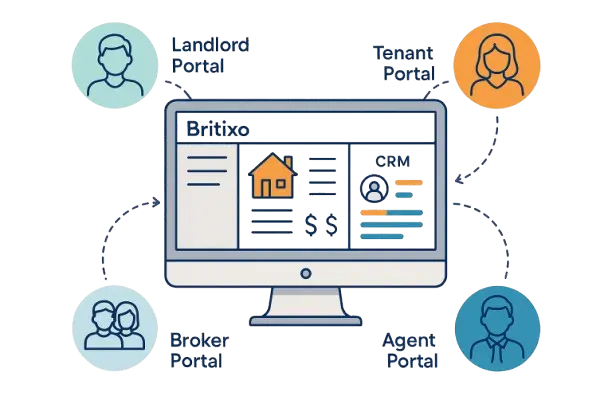
Britixo offers role-based login portals, giving landlords, tenants, brokers, and agents dedicated access to the information they need. Landlords can view financials, tenants can pay rent and raise requests, and agents can manage listings and deals — all from their own secure accounts. This transparency reduces calls, emails, and disputes.

Britixo Iconic Logo

Tailored Modules for Real Estate Agency UK.

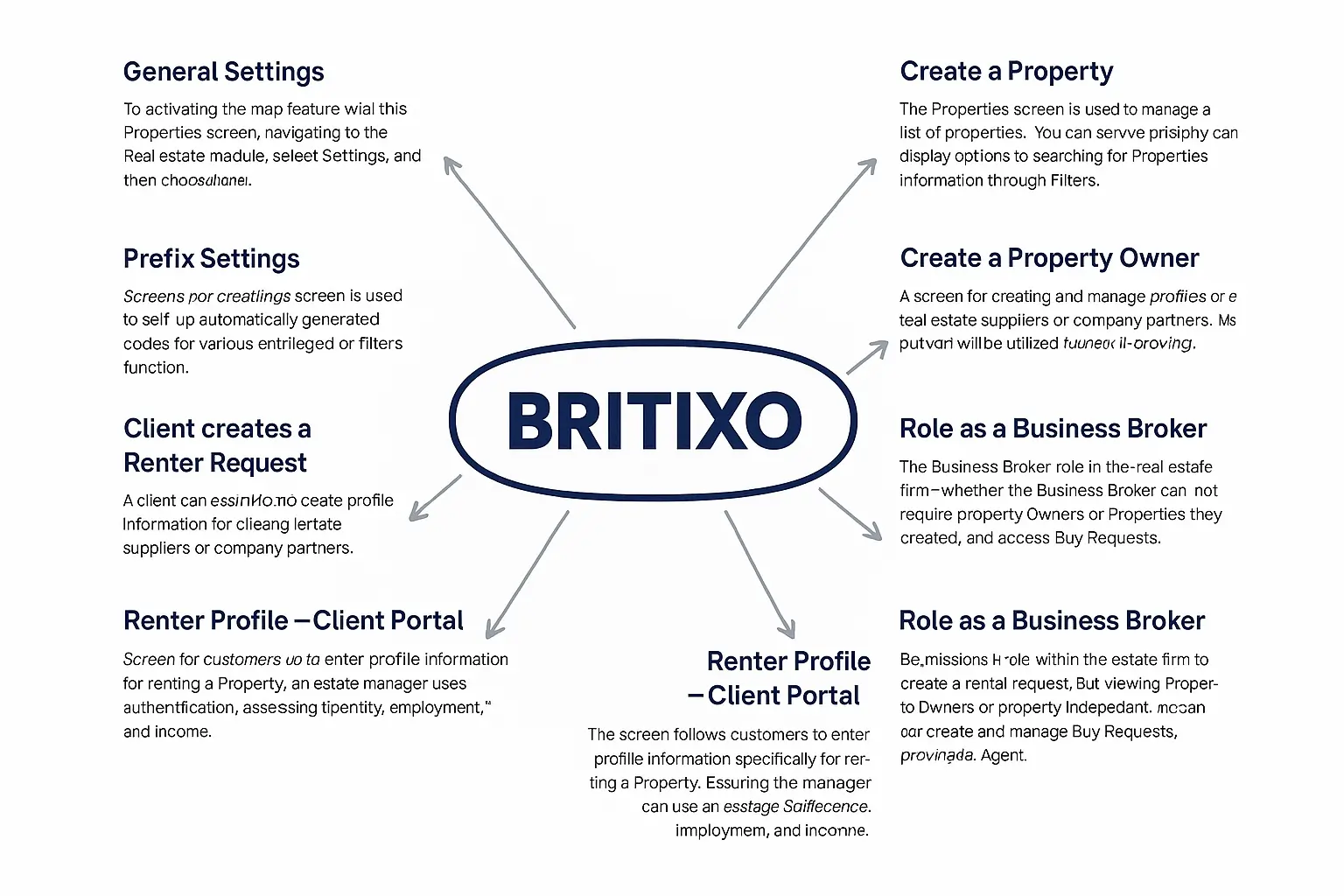
Manage your entire property pipeline in Britixo. Create listings, schedule viewings, track offers, and record approvals in one system. Whether handling residential lettings or commercial units, agents can see the full status of each property and coordinate with clients seamlessly.
Britixo-Real-Estate-and-property-management-pms-with-crm-flow
Britixo Iconic Logo

Everything You Need, All in One Place.

Britixo replaces filing cabinets and email chains with a secure cloud repository. Upload tenancy agreements, lease contracts, compliance certificates, and inspection reports. Built-in e-signature support makes it easy to execute agreements quickly, while version tracking ensures you always access the latest document.

Britixo-Real-Estate-and-property-management-pms-with-crm-flow
Britixo Iconic Logo

AI-Automation For Financials.

Automate rent collection with recurring billing schedules, late fee triggers, and reminders. Generate VAT-ready invoices for landlords and tenants, fully aligned with UK HMRC requirements. Integrated payment gateways such as Stripe and GoCardless allow clients to pay securely online.

Britixo-Real-Estate-and-property-management-pms-with-crm-flow
Britixo Iconic Logo

AI Shall Handle Entire Flow.

Assign tasks for property viewings, maintenance work, or approval requests with automated reminders. Use Britixo’s workflow engine to define rules — for example, “send a notification to the landlord when a tenant raises a maintenance issue.” This reduces admin burden and ensures accountability.

Britixo-Real-Estate-and-property-management-pms-with-crm-flow
Britixo Iconic Logo

Professional Reporting Module.

Stay on top of performance with clear reports:

  • Occupancy rates and rental income

  • Agent performance metrics

  • Outstanding invoices and arrears

  • Landlord portfolio summaries
    Customisable dashboards allow managers to track KPIs in real time.

Britixo-Real-Estate-and-property-management-pms-with-crm-flow
Britixo Iconic Logo

Pre-activated Built-In Modules.


Pre-Integrated
PMS (Practice Management System)
CRM (Customer Relationship Management)
Modules.


Britixo Iconic Logo

Built-In (UK Compliant) PMS For Real Estate & Property Management.

Britixo delivers all the tools your real estate business needs, without the hassle of switching between apps. Our key features include:

Britixo Iconic Logo

Everything You Need, All in One Place. (Real estate PMS with CRM)

Every version of Britixo CRM—whether designed for real estate agencies, legal practices, accounting firms, or other service-based industries—comes fully equipped with a powerful suite of over 38 built-in features. These core modules are not optional add-ons; they are standard inclusions in every deployment, ensuring that you get an all-in-one platform from day one.

Client
Management.

Contact & Company Management
Lead Capture & Management
Sales Pipeline & Deal Tracking
Custom Fields & Tags
Lead Source Tracking
Lead forms & Data
Role-Based User Permissions
Real-Time Notifications
Import/Export Tools
GDPR-Compliant Data Handling

Billing &
Client Access.

Invoicing & Estimates
Recurring Billing & Subscriptions
Expense Tracking
Payment Gateway Integration (Stripe, PayPal, etc.)
Contracts & E-Signatures
Proposal Builder
Client Portal with Secure Access
File Attachments per Client or Deal.
Records Management
E2E Encryption
Secured Encrypted Drive

Projects &
Collaboration.

Task & Activity Scheduling
Project Management (Kanban & Milestone View)
Calendar & Reminders
Team Collaboration Tools
Tasks, Leads Automation
Time Tracking
Activity Logs & Audit Trails
Mobile-Friendly Interface

Liaison,
Insights &
Integrations.

Email Integration & Templates
Bulk Email & SMS Options
Reports & Analytics Dashboard
Goal Tracking & KPI Monitoring
Knowledge Base & FAQs
Ticketing & Support System
Survey & Feedback Tools
2-Factor Authentication
API Access & Webhooks
Integration with 3,000+ Apps (Zapier, Pabbly, Integrately)
Custom Branding Options
Multi-Currency & Multi-Language Support

Britixo vs Competitors.

Most property management software charges by per unit or (per property or tenant), which can quickly become expensive for growing agencies. Others are US-centric, lacking UK VAT invoicing or GDPR focus.

Here’s how Britixo compares

Pricing & Value Proposition

The UK property sector demands modern, compliant, and scalable management solutions. Britixo delivers exactly that: an all-in-one PMS with CRM & Accounting Software built for UK real estate professionals, with unlimited client capacity and transparent pricing.

Forget juggling multiple systems, per-unit fees, or compliance worries. With Britixo, you get one secure hub for landlords, tenants, brokers, and agents — helping your agency save time, reduce costs, and grow with confidence.

Britixo Real Estate PMS
For just £149/month, real estate firms get:

Unlimited landlords, Properties, tenants, and brokers.
Fully compliant & AI Based PMS with CRM.
6 internal staff users included.
Additional users at just £10/month.
All features: CRM, PMS, invoicing,
automation, reporting, and compliance.
This flat model offers predictable, scalable pricing, saving agencies thousands compared to per-unit competitors.

For example:

Managing 500 tenants on Buildium
could cost $500+ monthly.

With Britixo, the same agency pays
just £249 flat — no surprises.

Dedicated Real Estate Modules:

Pre-Integrated PMS & CRM:

Get Started with  Britixo  Real Estate PMS.

Free 14-Day Trial - NO CC REQUIRED*

Scroll to Top