Complete work with fewer handovers
Connect requests, approvals, assigned tasks and status changes so people know what happens next. Measure the journey that matters rather than simply counting features.

Custom software development · UK
Turn the way your business works into software that helps people get things done. Britixo brings custom applications, integrations and the technology around them into one coordinated delivery relationship.
One coordinated offering. Inclusions and responsibilities agreed for your project.
A better fit for the work
Perhaps your team enters the same information in several systems. Customer requests arrive by phone, email and messaging, while approvals live in a spreadsheet. Reporting takes too long because nobody is sure which record is current. These are useful starting points for a software conversation.
Britixo designs bespoke software around the people, decisions and information behind the process. We can bring a customer portal, internal workflow, CRM, ERP capability or SaaS product into a coherent service, with clear ownership from the initial requirement to live operation.
The first question is what needs to improve. A focused integration may be enough; another organisation may need an entirely new application. Our bespoke-versus-off-the-shelf guide explains how to compare the options without assuming that everything must be rebuilt.
Make the outcome clear
These are examples to explore during discovery. Each project needs its own baseline and acceptance criteria.
Connect requests, approvals, assigned tasks and status changes so people know what happens next. Measure the journey that matters rather than simply counting features.
Agree which system owns each record, how changes flow and who can correct an exception. Connect reporting to information the business can explain.
Give customers or partners a clear route to submit information, follow progress and receive the right response, with appropriate access to their records.
Document decisions, keep responsibilities clear and plan for supported dependencies, release checks and maintenance as the service develops.
Choose the right starting point
Custom software development is a way to solve a business problem. It does not require replacing everything you already use.
Where a supported product fits the core process, configuration can be the sensible starting point. We assess Ready-to-Integrate modules and enterprise capabilities against your actual requirements.
Keep useful platforms and build the missing connections. API development and integration can connect customer records, finance, reporting and communications, with clear permissions and failure handling.
An older application may contain valuable business rules. Legacy software modernisation identifies what to retain, what to change and how users move safely to the improved service.
A tailored web application, portal or product can address requirements that standard tools cannot reasonably accommodate. Start with the smallest complete journey, then develop the service through evidence and feedback.
Depending on the requirement, the work may include CRM software, ERP software, SaaS product development, web applications, mobile applications or a focused MVP. These are starting points for scope, not compulsory parts of a package.
From the first requirement to ongoing support
The journey introduced on our homepage becomes a practical delivery plan for your software project.
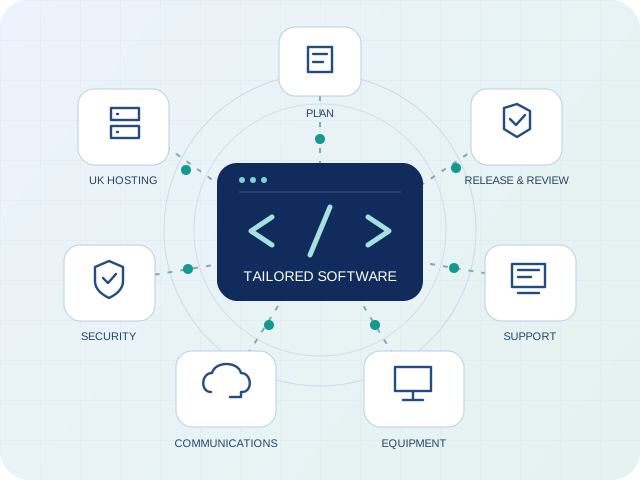
Our complete technology journey connects the application with the infrastructure, protection, communications and people around it. The milestones describe responsibilities and reviewable outcomes. Workstreams can overlap: security, hosting and support requirements begin during discovery. The agreed project determines which services are included.
We begin with the people using the service, the work they need to complete and the points where information or responsibility gets lost. Walk through real examples, including exceptions, with the team that knows the process. Current software, reporting, data quality, budget and timing constraints belong in the same conversation.
The discovery brief identifies priorities, inclusions, exclusions, assumptions and dependencies. We assess whether an existing platform, a Ready-to-Integrate module or a tailored application offers the strongest fit. Early prototypes or feasibility work can answer a specific uncertainty before a larger commitment.
Design connects the user journey to information architecture, permissions, data and integration contracts. The team can review prototypes before complex behaviour is built. Engineering then progresses through working increments, with demonstrations focused on complete tasks rather than isolated screens.
A customer portal, for example, may need submission, review, correction, approval and a reliable record of the outcome. We include relevant exception handling and administration in the agreed release. Integrations are tested for unavailable suppliers, repeated events and conflicting records as well as successful responses.
The operating plan considers capacity, connectivity, access, deployment and monitoring. Britixo-managed UK datacentre infrastructure can support the service where it is the right fit; an existing estate or public-cloud dependency may also form part of the agreed architecture. The location and responsibility for each component should be explicit.
Environments, release permissions, configuration and operational checks are planned alongside development. Recovery arrangements follow the agreed service requirements and authorised procedures. Third-party platforms, carrier services and external data processing retain their own boundaries and must be assessed within the complete design.
Security starts during discovery, not at the end of development. We map who can see and change information, separate privileged actions and consider how identities, devices, networks and integrations affect the application. Relevant controls are turned into requirements that can be reviewed and tested.
Application review, secure configuration, dependency maintenance, monitoring and incident preparation are coordinated within the agreed scope. Specialist penetration testing, regulatory advice or additional assurance can be specified where needed. Evidence and unresolved findings are recorded; no technology removes the need for informed risk decisions.
Where communications are in scope, we connect people, routing and customer context. VoIP, PBX and SIP services can sit alongside the application, CRM and support workflow. WhatsApp can connect an enquiry to an assigned owner and a recorded next action, subject to the supported connection and provider rules.
The plan covers users, extensions, routing, relevant integrations and the behaviour staff should expect. Britixo operates its UK core PBX/SIP platform, while external carriers and public connectivity have separate responsibilities. Platform offers, equipment, external calls, numbers and messaging-provider charges are distinguished in the proposal.
A successful application depends on the devices and connectivity people actually use. We assess existing equipment and, where included, help specify computers, peripherals, networking and communications devices around the role. Mobile users may need a different experience from an office-based team.
Procurement, availability, licences, warranties and any additional costs are confirmed before commitment. Configuration and rollout cover the agreed access, connectivity and user guidance. A device is ready when the person can complete the required work, not simply when the box has arrived.
Handover connects the build to the people who operate and support it. It can include runbooks, access ownership, supplier dependencies, known issues, training and a prioritised improvement backlog. Software maintenance, incident handling and new development have distinct responsibilities that should remain easy to understand.
Britixo’s support desk provides 24/7 ticket submission; coverage, response and resolution arrangements follow the agreed service. Service evidence then helps prioritise improvements: recurring support requests, slow journeys, changing business rules or unnecessary manual work. Each improvement should have an outcome and a decision owner.
Modern technology, with a reason
We assess supported technologies against the user experience, existing estate, performance requirements and the team that will maintain the application.
React, Next.js, Vue, Angular and TypeScript can support responsive interfaces. Public content and internal workflows may need different rendering strategies. Accessibility and keyboard interaction belong in the design.
Node.js, Python, PHP/Laravel, .NET and Java/Spring Boot are options for application logic and integrations. Clear contracts and maintainable boundaries matter more than adding unnecessary services.
Relational data, reporting and search are designed around ownership, transactions and access patterns. PostgreSQL, MySQL, SQL Server and other stores are selected for a defined requirement.
Responsive web, Flutter, React Native or native applications can suit different needs. Connectivity, device functions, user roles and interrupted tasks help determine the right approach.
UK infrastructure, public-cloud services, containers, delivery pipelines and infrastructure-as-code are considered in context. Monitoring, supported dependencies and operating effort are part of the decision.
AI-assisted search, classification or drafting can be useful where quality is evaluated. RAG systems need appropriate retrieval permissions, source quality and human oversight. A simpler rules-based process may be a better fit.
Explore our technology capabilities, AI software development and architecture and technology guide. Version support, compatibility, security and cost are reviewed for the proposed release. A new framework or an AI feature should earn its place through a useful outcome.
One coordinated offering
The application is only one part of a working service.
Britixo brings together IT consulting, software engineering, UK datacentre hosting, cloud infrastructure, cyber security, communications, equipment and managed IT. The scope identifies which capabilities your project needs, who delivers them and where a supplier or customer team retains responsibility.
VoIP, PBX and SIP services can connect staff and customers to the application. Britixo’s stated offer includes free PBX/SIP platform setup and worldwide internal team calls. External calls, number services, equipment and applicable provider charges are separate.
WhatsApp Business API platform access, integrations and setup are offered free under the stated platform arrangement. The supported connection and included workflow are agreed before activation; applicable messaging-provider rules and charges remain separate.
Equipment provision and configuration can help staff use the service effectively, while software maintenance and support connects future fixes and improvements to a clear owner. See the service catalogue for the broader offering and our CRM, VoIP and integration guide for connected workflow examples.
One relationship makes coordination easier. It does not replace a clear proposal: inclusions, recurring services, optional work, licences and third-party usage costs are agreed for your project.
Evidence before release
Agree the checks before launch, then use the findings to make an informed release decision.
Review critical journeys, roles and business rules with representative information. Test integration failures and permission boundaries, and protect existing functionality when changing a live system.
Agree accessibility expectations and relevant manual checks, alongside performance criteria for meaningful workflows. Test under representative conditions rather than promising one speed for every device and network.
Define data mapping, reconciliation, cutover responsibilities and verification. Record feasible rollback or recovery steps and any irreversible effects before the authorised release.
Document access ownership, configuration, known limitations and how to report a problem. The support agreement distinguishes maintenance, incidents and future development.
Our product discovery, UX and service design, quality and security and hosting and continuous improvement capabilities support this work. Cost, delivery dates, code ownership, licences and commercial acceptance terms are documented in the agreed proposal.
Plan with useful detail
Explore the decisions behind the build, from the business case to a supported live service.
Compare tailored software, configurable platforms and ready-made applications. Understand workflow fit, ownership, integration and lifetime cost with Britixo.
Learn moreUnderstand what shapes a custom software budget: scope, integrations, migration, testing, hosting and support. Plan a useful first release with Britixo.
Learn more
Plan legacy software modernisation with Britixo. Assess existing workflows, preserve critical behaviour, migrate data and introduce changes in controlled stages.
Learn moreChoose an appropriate software stack with Britixo. Explore web, mobile, APIs, data, cloud and AI, with maintainability, security and operational cost in view.
Learn more
Connect CRM records, VoIP, WhatsApp and business applications with Britixo. Plan data ownership, permissions, integration failures and a supported handover.
Learn more
See how Britixo connects requirements, staged releases, testing, hosting, security, communications and support with clear milestone evidence and ownership.
Learn moreUseful answers
Tailored software is designed or adapted around specific users, workflows and business rules. It can be a new application, an extension to an existing platform or a combination of standard software and custom integrations. The aim is a useful fit, not custom code for its own sake.
No. A ready-made product or configured platform may already meet the requirement. We compare those options with a tailored build using workflow fit, integration needs, operating costs and the ability to change.
They form one coordinated offering, with inclusions agreed per project. The proposal identifies software delivery, infrastructure, security, communications, equipment and support responsibilities, together with any separate charges.
Scope, business rules, integrations, data migration, assurance and operating requirements determine the estimate. Discovery makes assumptions and dependencies visible before dates or commercial commitments are agreed. A useful first release can be planned separately from later improvements.
Yes, where assessment supports that route. A targeted change, integration, supported upgrade or staged modernisation may protect useful existing behaviour and reduce disruption. The recommendation should explain the evidence and trade-offs.
We assess the intended workflow, available interfaces, permissions and provider requirements. The agreed design covers record ownership, mapping, failures and operational handover. Platform offers and external usage charges are confirmed separately.
We consider supported technologies and AI capabilities where they solve a defined problem. Compatibility, maintainability, privacy, cost and test evidence guide the choice. An AI feature needs appropriate data access, evaluation and human oversight.
Code ownership, licences, access, documentation and handover are set out in the agreed contract. Support scope, coverage and response arrangements are also explicit. These terms should be understood before development begins rather than assumed from the word bespoke.
Start with the work you need to improve
Bring the process, the people involved and the systems that need to connect. We will help define a useful next step, whether that is discovery, an integration, modernisation or a tailored build.
Continue with our complete technology journey or explore web and software delivery capabilities.
Britixo live search